Feedback Hub
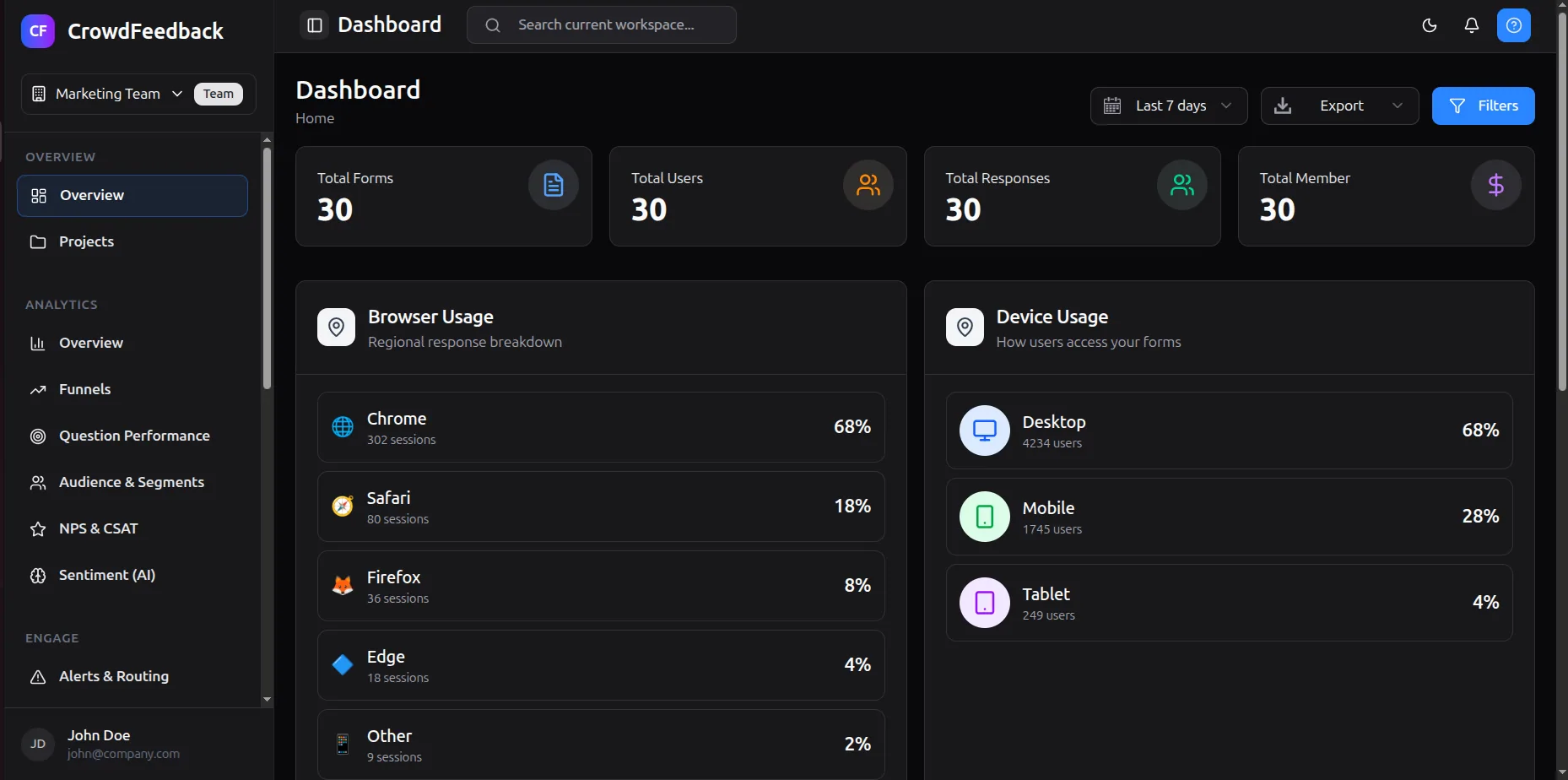
Feedback Hub is a full-stack feedback and survey SaaS for building forms with a drag-and-drop builder and conditional logic, sharing them through public links, QR codes, or tracked campaign links, and turning responses into funnel, NPS, sentiment, and segment analytics. NPS-triggered follow-up emails with open tracking, Slack project notifications, custom branding, an audit log, multi-workspace roles, and Stripe billing run on a Next.js frontend backed by a dedicated Fastify + tRPC API over PostgreSQL.
Problem
A team that collects feedback usually runs five tools at once: a form builder, a spreadsheet for responses, an analytics product, an email tool for follow-ups, and a billing system. Nothing shares a workspace, roles, or a single place to act on what a respondent said — so the loop from "ask" to "follow up" never closes in one place.
Approach
Feedback Hub is a full-stack feedback SaaS that owns the whole loop: a drag-and-drop form builder, public sharing by link or QR code, response collection, an analytics layer (funnels, NPS, segments), and follow-up emails to the people who answered — inside multi-workspace teams with role-based permissions and Stripe subscription billing.
A Next.js App Router frontend talks to a dedicated Fastify 5 + tRPC backend over PostgreSQL (Drizzle). The frontend imports the backend only as a type, so the API contract is shared end to end with no server code in the browser bundle, and both sides validate with the same Zod schemas.
Key features
- Drag-and-drop form builder — projects and questions as reorderable blocks with conditional logic rules; publish, duplicate, or close a form, and brand the public page per workspace.
- Sharing, campaigns & responses — public links and QR codes, responses tagged by the campaign link they arrived through, saved drafts, and per-form response limits.
- Analytics & export — dashboards for funnels, NPS and question performance, grouped by tag or auto-segment, with Excel/CSV export of the underlying dataset.
- Follow-ups & notifications — an NPS score opens a pending detractor or promoter follow-up that a person reviews before it sends, drawn from a reusable message-template library with an open-tracking pixel; a workspace Slack webhook posts project changes.
- Workspaces, roles & billing — multi-workspace teams, emailed invitations, an audit log, API keys, and per-workspace Stripe subscription tiers.
- Auth — JWT access/refresh/invite tokens (each with its own signing key), OTP-based 2FA, Google OAuth, and password-reset history, with sessions carried in HttpOnly cookies.
Platform
| Layer | Technology | Where it runs |
|---|---|---|
| Frontend | Next.js App Router | Vercel |
| API | Fastify 5 + tRPC (Node.js) | PM2 behind nginx on an AWS EC2 instance |
| Database | PostgreSQL via Drizzle | AWS RDS |
| Sessions & jobs | Redis (refresh sessions, BullMQ queues) | reachable via REDIS_URL; feature-gated |
| Media | S3 object storage | Amazon S3 (MinIO locally) |
| SMTP | provider via SMTP_* (Mailpit locally) | |
| Billing | Stripe | Stripe API + signed webhook |
The frontend and backend deploy independently — a Vercel build for the web app, a PM2 restart from a self-contained bundle on EC2 — and share nothing but the tRPC type contract. Every service after the database is feature-gated: Redis, SMTP, S3, Stripe, OAuth and PostHog each stay off while their env vars are empty, so the API boots on DATABASE_URL alone.
System diagram
flowchart TD
  subgraph Web["Next.js App Router · Vercel"]
    Builder[Form builder & dashboards]
    Public[Public form · /form/share token]
  end

  Web -->|type-safe tRPC over HTTP, cookies| API

  subgraph Server["Fastify 5 · PM2 + nginx · AWS EC2"]
    API["@org/backend baseline<br/>request-id · helmet · CORS · /health"]
    API --> Router[tRPC appRouter]
    Router --> Svc[Service · one folder per use case]
    Svc --> Repo[Repository · Drizzle queries]
    Hook["POST /webhooks/stripe<br/>raw body · signature verified"] --> Svc
  end

  Repo --> DB[(PostgreSQL · AWS RDS)]
  Svc -.sessions + BullMQ jobs.-> Redis[(Redis)]
  Svc -.follow-up email.-> SMTP[SMTP]
  Svc -.media.-> S3[(Amazon S3)]
  Stripe[Stripe] --> Hook
Stripe is the one inbound exception to the tRPC path: its webhook runs in its own Fastify plugin scope with a raw-buffer body parser, so the signature is checked against the exact bytes while /trpc keeps receiving parsed JSON on the same server.
Request lifecycle
sequenceDiagram
  participant B as Browser
  participant V as Next.js · Vercel
  participant F as Fastify · EC2
  participant S as Service + Drizzle
  participant D as PostgreSQL · RDS

  B->>V: open page / submit form
  V->>F: tRPC call /trpc/router.procedure (HttpOnly cookies)
  F->>F: baseline — request id, helmet, CORS
  F->>F: procedure — validate Zod input, check auth level
  F->>S: call the use case
  S->>D: Drizzle query (one pooled connection)
  D-->>S: rows
  S-->>F: result
  F-->>V: typed JSON (or TRPCError via toTrpcError)
  V-->>B: rendered UI
A procedure validates its Zod input and auth level before any service runs, so a bad request never reaches the database. On UNAUTHORIZED the web client calls auth.refreshSession once and retries, so an expired access token is invisible to the user. Write paths can hand work off asynchronously — submitting a response enqueues a BullMQ job instead of blocking the responder — and errors cross the boundary as a typed TRPCError (AppError → toTrpcError), never a raw stack trace.
Decisions
- tRPC over REST — the builder and the public responder share one type-safe contract; the frontend imports the router as a type, so a change to a procedure is a compile error on the client, not a runtime surprise.
- Fastify 5 over Express — plugin scopes made the hard case clean: the signed Stripe webhook needs the raw request body while every other route needs parsed JSON, and a scoped body parser gives both on one server. The shared
@org/backendbaseline (request id, helmet, CORS, health probes) comes for free. - Drizzle over a heavier ORM — SQL-first, fully typed queries with no hidden query cost, and migrations that are plain readable SQL generated by
drizzle-kit. One pooled connection is cached per process. - Redis is optional, not assumed — it backs refresh-token sessions and the BullMQ job queues, but it is feature-gated: with no
REDIS_URLthe API still runs, only without those paths. Infrastructure is a choice the deployment makes, not a hard dependency. - Signed Stripe webhook — billing state changes are trusted only after the
stripe-signatureheader verifies against the raw body, never from a value the client sent.
My contribution
Sole full-stack engineer. Designed the service → repository layering, the type-only tRPC contract between the two apps, the isolated raw-body scope for the Stripe webhook, per-workspace access checks on every procedure, and the review-before-send follow-up pipeline. The frontend deploys to Vercel; the backend runs on PM2 behind nginx on an EC2 instance, against PostgreSQL on AWS RDS.
Hardest problem
One Fastify server had to verify a Stripe webhook signature — which needs the untouched raw request bytes — while every tRPC route needed parsed JSON. Parsing the body globally breaks the signature; not parsing it breaks everything else. The fix was to mount the webhook in its own plugin scope with a raw-buffer parser, leaving the global JSON parser in place for /trpc, so both contracts hold on the same process.
Project Screenshots
Related Projects

Real Estate Media Pricing Calculator is a web-based pricing platform that helps real estate media professionals generate accurate, market-based pricing recommendations for photography, videography, drone services, floor plans, virtual staging, and twilight photography across the United States. The platform uses verified market data from 2,695 real estate media businesses to provide location-specific pricing ranges with confidence ratings, helping professionals price services competitively and confidently.
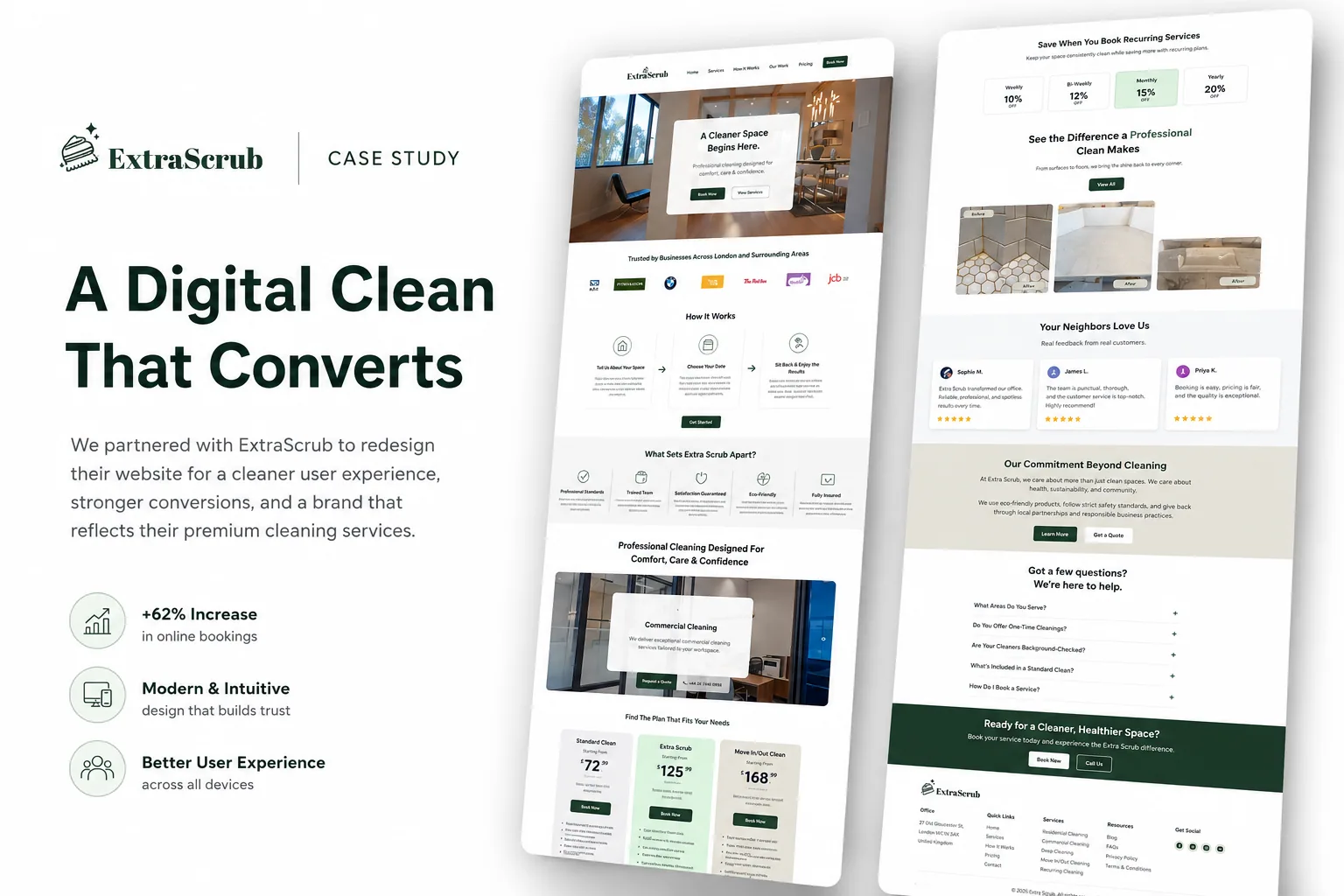
Extra Scrub Cleaning Services Website is a professional multi-page business website built for a cleaning company based in London. The platform helps customers explore residential and commercial cleaning services, request custom quotes, book appointments online, and contact the team easily. The goal was to create a modern, mobile-friendly digital presence that improves customer trust, simplifies service discovery, and increases booking conversions.
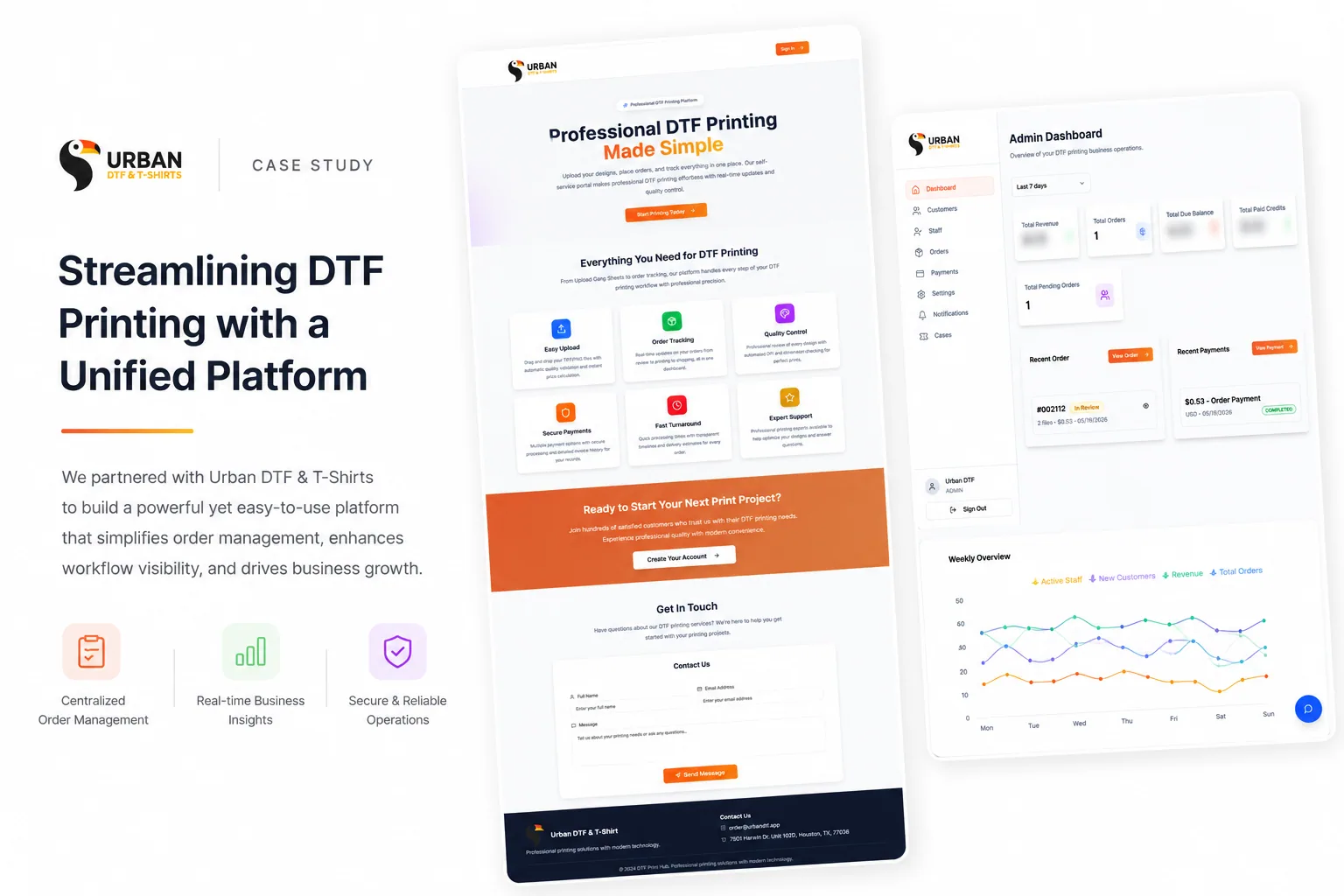
Urban DTF Customer Portal is a full-stack web application built for URBAN DTF & T-SHIRTS, a custom DTF printing business. The platform allows customers to upload designs, configure garment orders, make secure payments, and track production progress in real time. It helps streamline order management, reduce manual communication, and improve customer experience by transforming traditional printing operations into a fully digital workflow.